



BLOG

Q3450-LD Liquid-Cooling System
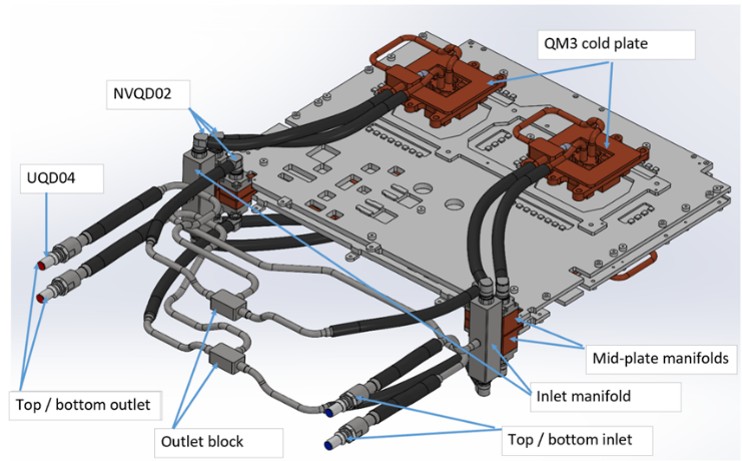
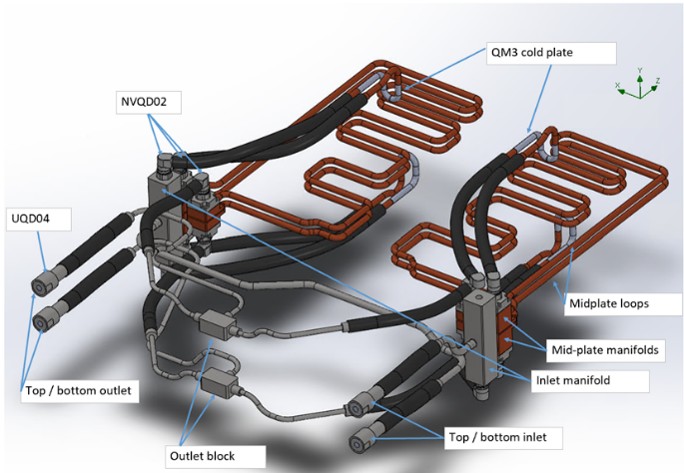
The Q3450-LD liquid-cooling system features two parallel cooling loops operating concurrently. Liquid enters via two separate inlet ports and exits through two outlet ports. Fluid enters through two inlet manifolds on the left and right sides of the system's rear part, each splitting into two paths: one to the upper QM3 cold plate (left/right) and one to the lower QM3 cold plate (left/right), forming two parallel loops.
After cooling the QM3 cold plates, the fluid flows to the mid-plate manifolds, then cools the switch board components via upper and lower loops (left/right). Unlike the inlet lines, which are split by side (left/right), the outlet lines are grouped by level: upper sections from both sides converge at the top outlet block, and lower sections at the bottom outlet block. The combined flow exits through ports on the left side.
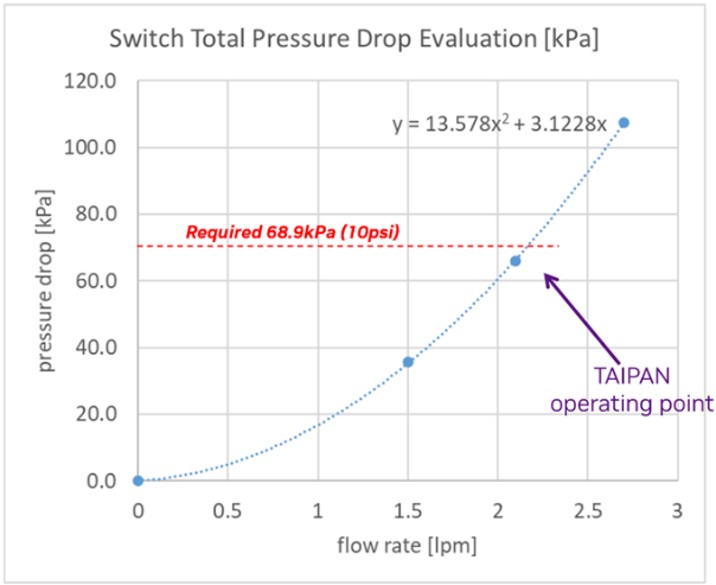
The system operates at [4.3 LPM, 10 PSI]. The below curve applies to PG25 at 45°C (see Specifications). As the system has two parallel inlet/outlet ports, the flow rate at the operating condition is half the total switch liquid flow rate.
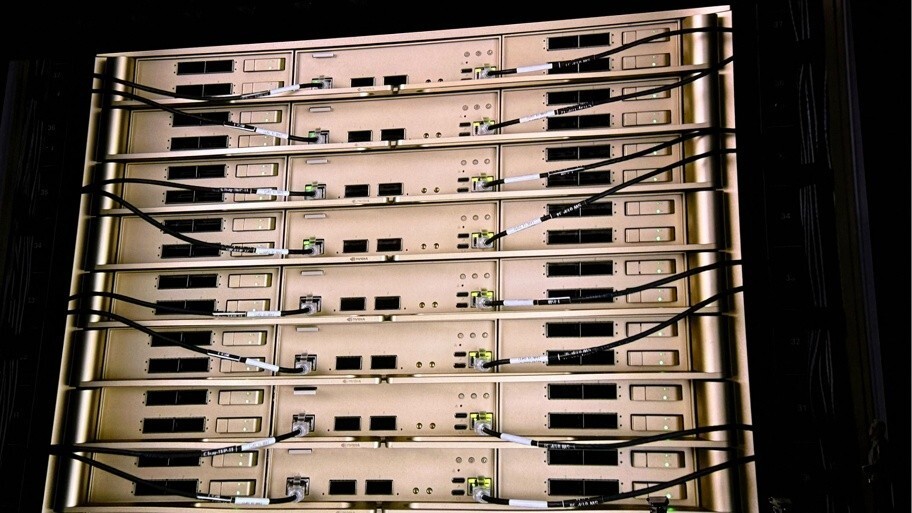
Nvidia launches Vera Rubin NVL72 AI supercomputer at CES
AI is everywhere at CES 2026, and Nvidia GPUs are at the center of the expanding AI universe. Today, during his CES keynote, CEO Jensen Huang shared his plans for how the company will remain at the forefront of the AI revolution as the technology reaches far beyond chatbots into robotics, autonomous vehicles, and the broader physical world.
First up, Huang officially launched Vera Rubin, Nvidia's next-gen AI data center rack-scale architecture. Rubin is the result of what the company calls "extreme co-design" across six types of chips: the Vera CPU, the Rubin GPU, the NVLink 6 switch, the ConnectX-9 SuperNIC, the BlueField-4 data processing unit, and the Spectrum-6 Ethernet switch. Those building blocks all come together to create the Vera Rubin NVL72 rack.
Demand for AI compute is insatiable, and each Rubin GPU promises much more of it for this generation: 50 PFLOPS of inference performance with the NVFP4 data type, 5x that of Blackwell GB200, and 35 PFLOPS of NVFP4 training performance, 3.5x that of Blackwell. To feed those compute resources, each Rubin GPU package has eight stacks of HBM4 memory delivering 288GB of capacity and 22 TB/s of bandwidth.
Samsung and SK Hynix to scale up memory production capacity in 2026 to meet AI demand
Memory chipmakers Samsung and SK Hynix are reportedly scaling up production of high-bandwidth memory (HBM) in order to meet growing demand from AI customers.
According to Korean news outlets, Samsung is looking to expand its production capacity by around 50 percent in 2026, while SK Hynix has announced plans to increase its investment in infrastructure by more than four times the figure previously announced.
Both companies are currently constructing new fabs in South Korea to support these ambitions. Samsung’s P5 facility in Pyeongtaek, Gyeonggi, is expected to be operational by 2028, with SK Hynix’s M15X facility slated for utilization by mid-2027.
The news comes as the industry attempts to grapple with a shortage of storage and memory hardware, with the size and scale of many AI data center build-outs announced this year seemingly having caught the market off guard and resulting in a capacity crunch some are forecasting could last up to two years.
In October 2025, Samsung Electronics and SK Hynix struck a deal with OpenAI, which saw the three companies sign a letter of intent for the eventual supply of 900,000 DRAM wafers a month in order to meet the memory demands of its Stargate project.
That same month, Samsung said it was in “close discussion” to supply its next-generation HBM4 chips to Nvidia. Weeks later, the company announced plans to purchase 50,000 Nvidia GPUs, set to be deployed in a forthcoming AI factory, which will support its semiconductor manufacturing operations.
SK Group, the parent company of SK Hynix, also announced an Nvidia-powered AI factory to support semiconductor research, development, and production.

xAI plans third data center, Musk claims will bring capacity up to almost 2GW
Elon Musk’s xAI has bought another building for a planned data center, potentially bringing the company’s compute capacity up to “almost 2GW.”
On December 30, 2025, the tech entrepreneur posted on X, saying: “xAI has bought a third building called MACROHARDRR.”
Musk recently said xAI is working on a purely AI software company called Macrohard. He said Microsoft pun was tongue-in-cheek, but the project was "very real."
The Information reported that the data center, now only a warehouse, will be located somewhere near xAI’s natural gas power plant in Memphis, Tennessee.
When completed, this will be the company’s third data center after Colossus and Colossus 2, the former of which attracted controversy for the unauthorized deployment of 26 gas turbines.
Both facilities are also located in the general vicinity of Memphis.
xAI is best known for developing Grok, its own AI model.
In November of last year, xAI partnered with Saudi Arabia’s Humain to develop a 500MW data center in the Middle Eastern country.

Johnson Controls to invest S$60m to expand Innovation Center in Singapore
Johnson Controls has announced plans to invest up to S$60 million (US$44m) to expand its Innovation Center in Singapore. According to the company, the expansion will target the growing demand for more energy-efficient data center infrastructure across the Asia-Pacific region.
The investment, expected to take place over a five-year period, will focus on next-generation cooling, thermal management, and intelligent automation technologies designed for AI- and cloud-driven facilities.
Johnson Controls has said that it plans to grow its engineering team at the site to around 90–100 staff, with work centered on reducing energy use while supporting higher rack densities.
According to the company, research will include liquid and hybrid cooling systems suited to hyperscale and colocation data centers operating in tropical climates and power-constrained markets.
The Singapore site will also serve as a regional hub for the company’s data center research and development, supporting deployments across Asia-Pacific.
Data centers currently account for around seven percent of Singapore’s electricity demand, a figure expected to increase as AI workloads grow in market share. As a result, Johnson Controls has said that the facility is geared towards supporting operators seeking to meet sustainability targets while maintaining performance and uptime.

Munters wins record orders for data center equipment with a total value of 2.1 BSEK
Munters business area Data Center Technologies (DCT) has received orders for chilled water computer room air handlers (CRAHs), coolant distribution units (CDUs) and chillers with a total value of appr. 2.1 BSEK. The customer is a colocation data center company in the US and deliveries are scheduled to begin in Q4 2026 and continue through Q1 2028.
“Our long‑standing collaboration with this customer is grounded in their trust in Munters and our continued technology development. In a highly demanding environment, an engagement of this scope demonstrates the confidence customers place in our ability to scale and compete. The DCT team has built the portfolio and the capabilities to operate at the highest level —bringing operational rigor and technical depth to complex, large‑scale projects,” says Klas Forsström, President and CEO of Munters.
“These orders perfectly reflect the vision behind our Geoclima acquisition—broadening our participation in the value chain and supplying complete chilled water systems to customers. They include units for air cooling and liquid cooling, covering thermal management from the server rooms to outdoor heat rejection, combining our own developments with the technology we acquired. It follows our direction from niche excellence toward broader technology leadership,” says Stefan Aspman, President DCT and Group Vice President of Munters.

Applied Digital plans cloud unit spin-out
Applied Digital is seeking to spin out its cloud computing unit.
The data center provider is working with Ekso Bionics Holdings (Ekso) - a company that develops exoskeleton solutions - seeking to combine its cloud unit with Ekso into an AI cloud provider called ChronoScale Corporation.
Applied would retain around 97 percent ownership of ChronoScale, with Ekso holding the remaining shares. The deal is set to close in the first half of 2026.
Applied Digital, previously known as Applied Blockchain, shifted away from solely focusing on crypto in late 2022.
While the company develops and operates data centers across North America to cater to high-performance computing (HPC), it has a cloud offering previously known as "Sai Computing," though now seemingly named "Applied Digital Cloud," which offers a variety of Nvidia GPUs, including the H100 and H200s.
In March, the company said it would also be offering the Blackwell line of GPUs, though these are yet to be listed on its website.
At the start of December, Applied announced it had completed the first HPC data center building at its campus in Ellendale, North Dakota, bringing 100MW online. The company counts CoreWeave among its customers.
Founded in 2005 as a Berkley spin-out, Nasdaq-listed Ekso develops wearable exoskeletons. The company said in its own release that it plans to continue to explore strategic transactions for the possible sale of all or substantially all of Ekso’s current business.
Last year, Ekso joined the Nvidia Connect program and developed an AI proof of concept, deploying a new AI voice agent for one of its exoskeletons, powered by an Nvidia Jetson module.
SoftBank to buy data center investor Digital Bridge for $4bn
SoftBank Group plans to acquire digital infrastructure investor DigitalBridge for $4 billion.
DigitalBridge had around $108 billion of assets under management at the end of September, including AIMS, AtlasEdge, DataBank, Switch, Takanock, Vantage Data Centers, and Yondr Group.
As of August, the company had 5.4GW of data center capacity in development or operation.
Before the deal was rumored earlier this month, DigitalBridge was valued at $1.8bn. SoftBank is separately believed to be in talks to acquire Switch.
Alongside data center investments, DigitalBridge owns stakes in telecoms towers and fiber networks.
This November, the company sold its entire stake in Nvidia for $5.83bn to help fund its OpenAI plans - a move that Son said made him cry.
DigitalBridge portfolio company Vantage is behind one of the Stargate projects, a near-gigawatt data center in Wisconsin.
DigitalBridge's CEO Marc Ganzi added: “The buildout of AI infrastructure represents one of the most significant investment opportunities of our generation.
The company will continue to operate as a separately managed platform, led by Marc Ganzi, with the deal expected to close in the second half of 2026.
A Korea Economic Daily Report Highlights Tightening Supply in the Server Memory Market
According to a January 5, 2026 report from Korea Economic Daily (KED Global), South Korea’s leading memory manufacturers — Samsung Electronics and SK Hynix — are seeking to raise server DRAM contract prices by as much as 60%–70% in the first quarter of 2026, compared with Q4 2025 levels.
The report cites industry sources involved in ongoing negotiations, indicating that the proposed increases are primarily focused on server DRAM, reflecting strong demand from data centers and AI infrastructure deployments. While the article notes that similar price discussions have been extended to PC and smartphone DRAM customers, server memory remains the central driver behind the proposed increases.
Why Server DRAM Is Under the Most Pressure
AI and Cloud Infrastructure Are Driving Server DRAM Demand
Memory Makers Are Allocating Capacity Strategically
Memory Makers Are Allocating Capacity Strategically
It is important to clarify that the reported increase represents pricing proposals, not officially confirmed contract outcomes.
Historically in the DRAM market:
Initial proposals often set a high negotiation anchor
Final pricing may settle below headline figures
However, once suppliers push for increases at this scale, the overall direction rarely reverses

Ground broken on 30m sq ft data center for Saudi Arabian gov't
Ground has been broken on a new data center for the Saudi Arabian government in Riyadh.
On January 1, the foundation stone of the Saudi Data and Artificial Intelligence Authority's (SDAIA) Hexagon data center was laid in a groundbreaking ceremony.
In a series of LinkedIn posts shared by SDAIA, the authority revealed that the project had commenced for the data center, which will ultimately span 30 million sq ft (2.78m sqm) on a site in Riyadh.
The data center will have a power capacity of 480MW, with its Tier IV design certified by Uptime Institute.
Based on images of the upcoming facility, it is aptly named after its design - two concentric hexagons with a court in the middle of the facility.
The data center will host more than 290 government systems, and has been designed to meet "green building requirements.“
During the groundbreaking ceremony, SDAIA president Abdullah bin Sharaf Al-Ghamdi said: “The Hexagon data center will be followed by the establishment of other centers. This center is a qualitative strategic boost toward making the Kingdom a global center for data, ensuring data sovereignty and security, and enabling innovation and a digital economy."
The SDAIA was established in 2019. It launched with the slogan "data is the oil of the 21st century."
Saudi Arabia is home to several large data center projects. Throughout 2025, the likes of xAI and Humain have agreed to build a 500MW data center in the country, STC is developing 1GW of capacity also with Humain, while Khazna has detailed a 1GW data center growth pipeline, just to name a few.

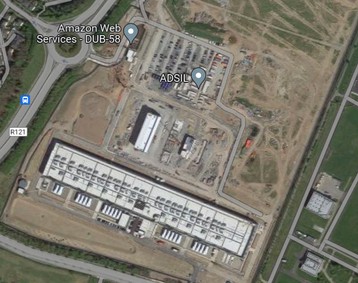
AWS gets greenlight for three data centers in Dublin, Ireland, again
Amazon Web Services (AWS) has received planning permission for three data centers in north Dublin, Ireland.
The greenlight, awarded by planning appeals body An Coimisiún Pleanála (ACP), comes three years after the application was first filed by Amazon affiliate Universal Developers LLC, reports the Irish Independent.
Fingal Council previously approved the project in 2023, but the application was delayed after five appeals were lodged with ACP seeking to prevent the project from going ahead.
As recently as July 2025, AWS claimed that the project would have no 'significant impact on climate' in response to those appeals.
The company secured a grid connection with EirGrid for the buildings in 2019, meaning the facilities avoid the ongoing capacity crunch and de facto moratorium in Dublin that impacted other developments in the city. According to documents in the filing, the buildings will have a combined power load of 73MW.
While the campus has been given renewed approval, it is conditional on AWS entering into a corporate Purchase Power Agreement (PPA) with a renewable energy provider, which must be equal to or greater than the energy requirements for the data centers.
Prologis eyes 13-building data center development in Illinois
Industrial real estate giant Prologis is planning a large data center development in Illinois.
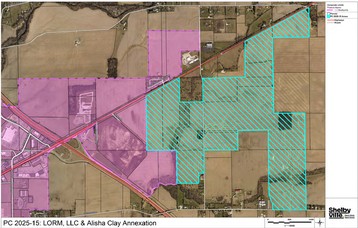
First reported by local news including Shelbyville News and Fox, Prologis is filing to develop a campus in the city of Shelbyville in central Illinois.
The campus would total up to 13 buildings, according to Prologis. No end user has been secured for the site.
Shelbyville is a city in and the county seat of Shelby County in central Illinois. It is some 200 miles south of Chicago, 100 miles northeast of St. Louis, and 150 miles west of Indianapolis.
The campus would reportedly use closed-loop cooling to reduce water usage.
In documents, city staff were in favor of the move and said the site was “ideal for industrial development” due to its location and existing electrical infrastructure, with two Duke Energy transmission lines through the site.
Mayor Scott Furgeson said the proposal aligns with the city’s long-term development goals.
The Shelbyville plan commission and city council are due to discuss the project at meetings this week.
The project, however, is set to face opposition from local residents. More than 2,100 people have signed a Change.org petition against the development.
Logistics and industrial real estate giant Prologis began expanding further into the data center sector in recent years. Many of the company’s data center developments to date have been focused on building out existing landholdings, but the firm has been acquiring greenfield sites as well.
Leave A Reply